Project Hail Mary is one of the most amazing sci-fi stories in recent years. A novel created by Andy Weir, later adapted into a groundbreaking film, it tells the story of a confused yet inspirationally brave space-faring astronaut named Ryland Grace, who tries to save the solar system from a star-eating alien microbe. Along the way, he meets another species of alien, an Eridian named Rocky, also trying to save his own planet Erid from the same microbe. Together, they bond like best friends and eventually save eachother’s solar systems. This is one of my favorite stories of all time; it’s as heartwarming as inspiring, and the worldbuilding is incredible. However, I did wish that the ecology of Rocky’s homeworld, Erid, was explored more deeply, especially since the basic conditions of the planet, as well as deep descriptions of the Eridians themselves, were already established. This gives us a lot of room for some exciting speculation, so that’s what we’ll be exploring today.
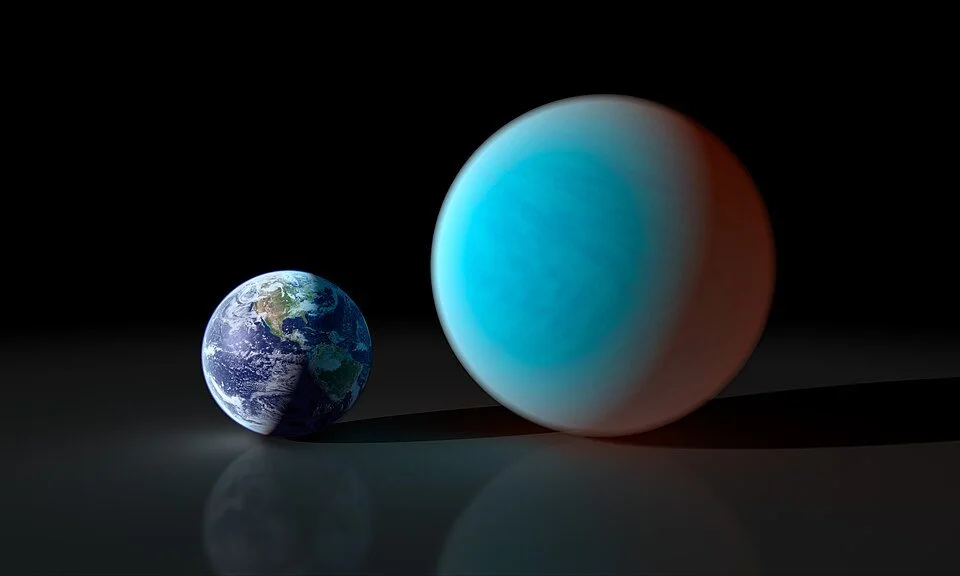
Erid is a huge rocky planet, similar to this real exoplanet 55 Cancri E.
Image credit: https://commons.wikimedia.org/wiki/File:Earth_and_Super-Earth.jpg
That’s no moon…
Erid is described by the author in his supplementary document as a high-gravity rocky planet (around 2 G’s of surface gravity) with a very thick atmosphere of 28 times the pressure of Earth’s, primarily made of Ammonia. Despite the surface temperature being over 200 degrees Celsius (Around 400 degrees Fahrenheit), hotter than an oven, liquid water still exists in abundance on the surface due to the thick atmosphere causing enormous amounts of pressure that keeps it in a liquid state. Erid also has a strong magnetic field for a rocky planet, over 25 times stronger than Earth’s. Combined with the atmosphere, this prevents any kind of radiation coming from space from reaching the surface, and so the entire surface of the planet is shrouded in pitch-black darkness. This gives us the framework for our speculative ecosystem. We’ll start from the base of the food-web and work our way up.
How could life exist in total darkness?
First of all, life needs energy to survive, no matter what kind of form it’s in. On Earth, most of surface life’s energy comes from the Sun, in the form of heat and solar radiation. However, we just established that there is no sunlight on the surface of Erid, so where does the energy for the creatures come from? Well, as you go high up into the atmosphere, the air gets thinner, and there is a lot more solar energy. Andy Weir’s document detailing Eridian biology describes “airborne microbes that live in the higher parts of the atmosphere. They absorb sunlight and consume the gasses in the air to multiply.” These microbes live high in the clouds and provide fuel for larger airborne animals that then die and come down to the surface. This makes up the foundation for the surface ecosystem energy cycle, and is similar to how the deep ocean food web exists on Earth.
Alien not-plants
On Earth, the bulk of producers (creatures that provide sustenance for many other animals) on land are plants. Unfortunately, photosynthesis is impossible on the surface of Erid since there’s no sunlight. So, all producers will have to rely on the energy from the falling atmospheric organic matter instead. A good example of plant-like creatures that do this on Earth are crinoids. These stationary animals use frond-like appendages to sweep up passing organic matter to feed on. A lot of species on Erid would probably use a similar strategy due to the abundant atmospheric life. These crinoid-like aliens could grow to large sizes, rivalling trees on Earth, their tentacles sweeping through the air like palm fronds. However, at some point, the high surface gravity of Erid would make it hard to keep bodily circulation going at huge sizes, so they might not reach the size level of Earth’s biggest trees.
Sessile marine deep-sea animals like Crinoids are good examples of what “vegetation” could look like on Erid.
Image credit: https://commons.wikimedia.org/wiki/File%3AExpl5406.jpg
Why is everyone turning into crabs?
Now we’re getting to the fun part: actually moving animals. The possibilities here are almost endless, and this blog would be unbelievably long if we explored all of them. So, we’ll focus on a couple of body plans and behaviors that some of the more common animals might have.
Eridians like Rocky are radially symmetric, meaning their body is symmetrical on more sides than 2. A lot of other animals on Erid would likely share this symmetry due to shared ancestry. The crab-like Eridian body plan is also very versatile, and could potentially fill many niches. So it’s probable that many of the other species on Erid would look somewhat similar to Rocky’s. Even on Earth, many lineages have independently evolved crab-like bodies; it’s an entire phenomenon called “Carcinization”. The Eridian forms could have extremely diverse niches, anything from small arboreal species with developed climbing limbs to large browsers that use long limbs to grab xeno-crinoid fronds from high up. Large predators could resemble massive, eyeless coconut crabs, with huge claws that work like nutcrackers.
Despite these Porcelain Crabs (Porcellanidae) looking like run-of-the-mill crabs, they are not closely related to true crabs (Brachyura). The armored body and pinchy claws are just too versatile for a lineage to pass up!
Apex Species
Finally, at the top of the Eridian food chain, we have the apex species. Andy Weir, in his document, has said that the Eridians (Rocky’s species specifically) are the “apex predators of the land ecology.” Due to their technological prowess, this is pretty understandable. However, I do wonder what place the Eridians had on the food chain before their rise to civilization. Their relatively small hands aren’t very suited for bringing down large prey, so they probably ate smaller prey items that they could easily process with their hands before they developed tools. It’s a remarkably similar history to our own: humans aren’t exactly suited to tackle a large antelope with our bare hands, and before we harnessed the mighty rock, we definitely weren’t at the top of the food chain. It’s yet another connection that allows us to relate to the Eridians like Rocky.
Closing Remarks
All in all, the Eridian ecosystem is one that anyone could speculate on for hours and hours. What weird alien creatures do you think could live on this fictional planet? Comment down below!